Friday, October 19, 2012
THE BIG REVEAL
The Casting Call is over, the talent has performed, and the votes have been counted. Three Talented Artist will be revealed later tonight, will you be the first to see "Who Will Play the Bennight Brothers". Keep your eyes peel or you just might miss it. Stay tuned for more info, news, behind the scenes and more @ www.BennightBrothers.com
Wednesday, October 3, 2012
3D Animation- Pay No Attention To The Man Behind The Screen.
Virtual Production, or Virtual Movie making, is a new, visually dynamic, non-linear workflow. It blends virtual camera systems, advanced motion and performance capture, 3D software and practical 3D assets with real time render display technology, enabling filmmakers to interactively visualize and explore digital scenes for the production of feature films and game cinematic's.
“Virtual Movie making can liberate filmmakers from the often stifling visual effects and animation process by allowing them to experience the production in much the same way they do while shooting live action. They are immersed in the world of their film and the entire production benefits immensely from that kind of immediate creative discovery and problem solving
Rob Powers, Pioneered the first
Virtual Art Department for Avatar (check out his amazing website by clicking his name)
Computer Performance
Several trends in computer performance are facilitating real time calculation and display of 3D computer scenes and animation:Central Processing Unit
The Central Processing Unit (CPU) of the computer has increased in speed. CPUperformance is measured in terms of clock speed (Hertz) – which is the speed at which the processor can change state from 0 to 1. At the time of writing processor performance exceeded 3:0 GHz or 3 billion cycles a second.
Multi-Core Processors
However there are physical limits to how far you can push processor speeds until you start getting undesirable quantum effects. As a result chip manufacturers have started developing multi-core processors instead of trying to increase clock speed. These processors offer more efficient and faster processing to highly multi-threaded applications –software where the processing algorithms have been specifically designed to run in parallel.Graphics Processing Unit
The Graphics Processing Unit (GPUs) is a specialized processor for rendering 3D graphics. Although many PC motherboards have GPUs built-in, high-end graphics cards from NVIDIA and ATI offer better performance. GPU efficiency and parallelization enable significant performance increases to applications whose rendering algorithms have been GPU optimized.3D Shaders
3D shaders are software instructions describing how 3D objects should be rendered. They are executed on the GPU (graphics processing unit) of a computer graphics card. Each shader provides precise instructions on how the 3D data should be rendered and displayed. Common types of shader include pixel, vertex and geometry shaders Shaders can be created using one of several specialized programming languages:- HLSL (High Level Shader Language)
- GLSL (OpenGL Shader Language)
- Cg (C for Graphics)
Recent developments in programmable graphics such as GPCPU (general purpose computing on CPUs) enable very sophisticated rendering pipelines to be implemented; and companies like Nvidia are further expanding graphics programming capabilities with technologies like CUDA (Compute Unified Device Architecture). One of the biggest challenges for developers remains the hardware specificity of many software development kits (SDK’s) and application programming interfaces (API’s). This can cause unpredictability in results and might require work to be done twice when working with different graphics pipelines (e.g. Direct3D versus OpenGL, Nvidia versus ATI). However the fact remains that continued progress in this field will drive increasing image quality and photo-realism in real-time graphics display.
To read more on this subject download your free Ebook from AUTODESK
®WHITEPAPER :The New Art of Virtual Moviemaking-Download -->Here<--
Sunday, September 30, 2012
BENNIGHT BROTHERS SERIES
"UPDATE"
The new Teaser trailer is out on YouTube tonight, so if you have about 20 secs to spare check it out. As we know "After the loss of their father to cancer, three brothers learn of a family secret left for them in a will that speaks of a vast treasure, both steeped in legend and myth. The Bennight brothers having lost the family's breadwinner now face eviction. They must set out to find this treasure in the hopes that it would save them from loosing their Family's home." Now we see a hint and possibly a peek into some of the back story, the trailers text block display the words "Three Brothers One Treasure" in the next block we see "13 Keys Unlock The Secret". These text clues as well as the visual ones give you an insight into the inner workings of the Bennight Brothers story. Stay tune for more Insights, posters, cast photos, in-the-making videos, music and more. Of course we would love your support on Facebook as well as on Twitter and Pinterest.
Monday, September 24, 2012
BENNIGHT BROTHERS SERIES
"Update"
After the loss of their father to cancer, three brothers learn of a family secret written and encoded in their fathers will, one that is both steeped in legend and myth that speaks of a vast treasure. The Bennight brothers having lost the family's breadwinner now face eviction. They must set out to find this treasure in the hopes that it would save them from loosing their Family's home.The series will follow three brothers who have spent most of their lives as shut-ins from society because of their mental disorders. In this world Mental disabilities are rare, to have three children all brothers with individual and unique disabilities is even more rare. As they explorer there world for the first time they will discover one of the worlds greatest secrets. Following a map left by their father they must set out to encounter and capture creatures of myth that will allow them to unlock a vast treasure, and lead them to the truth about their origins.
We are currently holding Auditions for cast members, if your interested sign up Here
Website:Bennight Brothers Series
Twitter: Bennight Tweets
Facebook: Bennight Facebook
Pinterest: Bennight Pinterest
Interview with 'We Colonised the Moon'
By Regine
on August 24, 2012 3:50 PM Original Site |
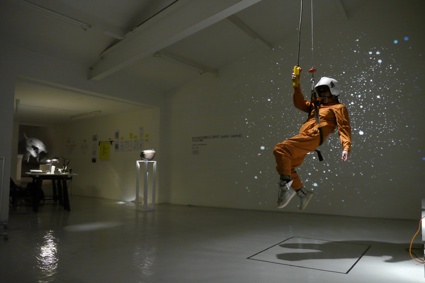
Space Maintenance / Lost in Space, 2012. Installation view at EB&Flow, London
Time machines, false memory, earthly landscape, moon rock gardening, flying saucers, lunacy, galactic adventures and the occasional rabbit. That's the world sketched by Sue Corke and Hagen Betzwieser. Roughly speaking, Sue is a printmaker and Hagen is a 'New New Media' artist but together they are more than the sum of their parts, they are We Colonised the Moon.
The work of WCTM is clever and nonsensical, dreamy and rooted in techno-scientific experiments. It is driven by its own logic. I'm not sure that the interview below is going to lift the whole mystery behind their work but i certainly had a lot of fun in the attempt.
Authentic Goods from a Realistic Future, at EB&Flow, London
Hello Sue and Hagen! I discovered your work a year ago, when you were showing '101 Harmless Scientific Experiments To Try At Home' at the Acme Project Space in London but you've obviously worked on many ideas and projects right after that. What are you up to this Summer?
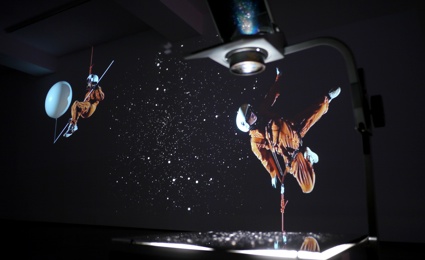
Sue: This summer we have had two shows running, at EB&Flow in London and Villa Rosenthal in Germany. The shows are both mostly dealing with work we have done together over the last couple of years. Most recently we have been working on ideas about astronaut training and space maintenance, shooting a lot of videos and building moon rocks out of authentic moon dust simulant.
Hagen: This is definitely the direction we are focusing on now. Installation, video projection, artefacts, movement and performance. We started more 2D for sure because we came together through making graphic work, we continue to make prints but most of the time we're working on installations now.
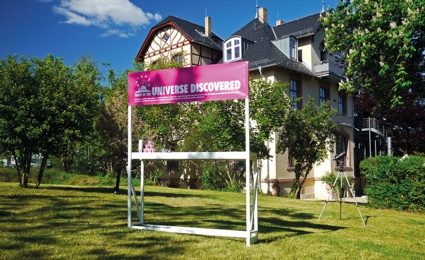
Taste of the Universe, 2012. Villa Rosenthal, Jena
You come from different backgrounds. Sue is involved in printmaking and illustration while Hagen used to work mostly with video and conceptual art. How did you two get to work together?
Sue: Pure accident. We literally bumped into each other at a bus stop in Norway. Hagen was in a residency programme at the Nordic Artists' Center in Dale (NDK) and I was visiting to make a short illustration project about forests and star constellations there.
At NKD, Norway, 2008
Hagen: It all started a bit like RUN DMC and Aerosmith working together as studio neighbours.
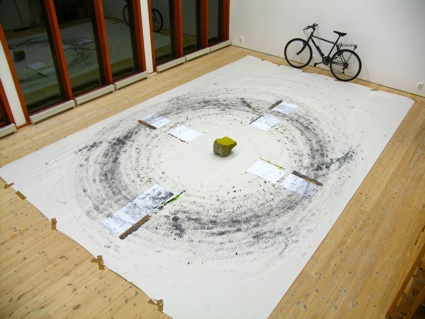
When I met Sue I had just finished a DIY particle collision experiment in my studio. Whilst the first beam of the Large Hadron Collider was fired I was riding my bike in circles over wet paint for ages until I was hell dizzy!
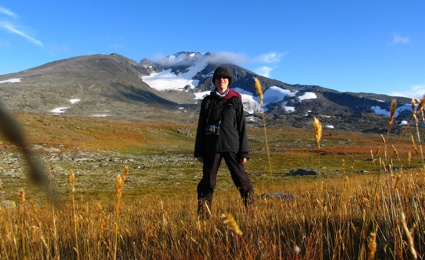
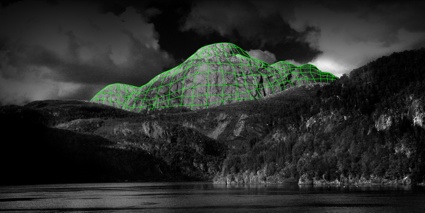
Sue: Dale is surrounded by the most amazing Norwegian mountain and fjord landscapes. We made an expedition to Sognefjellet, a Photoshop perfect wilderness, and had endless discussions about how reality is constructed. In the process we discovered some shared interests. We both had backgrounds in science and media. My parents were chemists. Hagen was a junior astronomer in an observatory close to Heidelberg in Germany. I worked for a spell in advertising and multimedia. Hagen had been an art director for a design agency.
Hagen: Through endless hikes and talks about The Clangers, YPS, Blue Peter, Particles, Heinz von Foerster, Constructivist epistemology and so on somehow we came to the point where we thought it could be an interesting idea to work on a project together.
Sue: The ideas we generated during this trip were so fun that I definitely wanted to work like this more. And it was obvious Hagen had absolutely no idea about printmaking!
Hagen: True. I thought only about my little A4 laser jet. Oh boy :) But she convinced me the quick cartoon style sketches I make for my works would work really well as silkscreens. So this is how a nature encounter, theory, two different illustration styles, childhood interests, professional skills and ink became the starting point for our collaboration ... and even our name WE COLONISED THE MOON is made in Norway. Out of this small joint illustration / print project it became now an ongoing and growing collaboration since 2008.
Approved for all Ages, 2008-2010
You've '(re-)created' the smell of the moon in at least two exhibitions. How did you do that? How much of the result is the fruit of your imagination? Is this a pleasant smell?
Sue: Astronaut Charlie Duke, the tenth man to walk on the moon, said it was not unpleasant. The Apollo astronauts were drawn from the military. I think they knew what they were talking about when they likened the smell to gunpowder. Naturally this is their frame of reference but that's how we all interpret sensory information. I like the smell of burnt matches myself.
Hagen: No one can smell the moon directly of course. The vacuum in space prohibits this. But this gritty tacky meteor bombarded dust on the surface gets on to their spacesuits and back into the LEM. Then there is this massive reaction with oxygen and moisture. The loose molecules go off like firecrackers and generate the smell they experienced.
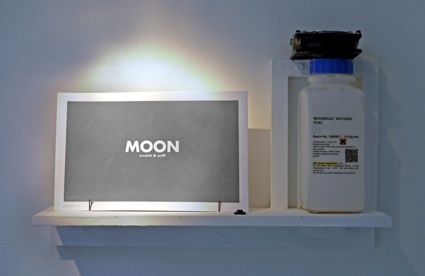
Sue: So, we had the smell synthesised by Steve Pearce, a chemist who is an international aroma expert in the UK. He makes flavours and smells commercially for his own company and had been approached by NASA some years ago to work on the smell of space for astronaut training.
Hagen: What's attractive to us about this phenomena is the strong link between smell and memory and the association with place, whether it's real or imagined is actually the crux the work we make hangs on.
Sue: Curator Caro Verbeek from the Stedelijk Museum Amsterdam knew we were working on the idea of space aromas and asked us to make a piece for her for the event "Do It Smell It" on olfactory art in 2010. We came up with the idea of a scratch and sniff postcard from the moon. A momento from a place most people will never go. A fictional memory.
Moon Scratch Sniff, 2010
Hagen: Then in 2011 for a commission from The Arts Catalyst and FACT Liverpool we created an installation for the exhibition Republic of the Moon. Visitors could enter (on own risk) a film-set like test chamber. Periodically an astronaut resprayed an array of "authentic" moon rocks with synthesised lunar aroma. As longer you stayed in the environment as more you got pollinated with moon smell. After you left, the smell travelled for several hours with you on your clothes out into the city.
Sue: At the moment we are also doing a lot of "Live Moon Smellings" using helium balloons and pins! We have enough smell left to pollinate an area twice the size of the Olympic stadium.
What's behind the name We Colonised the Moon?
Do you feel bound to do certain types of works that involve science, space because of it? If, for example, you'd decide to develop vegan cooking projects one day, would you do it under a different name?
Sue: I guess it's really a kind of band name. A comment one of us made when we saw how lunar the glacier region we visited in Norway looked. It just stuck.
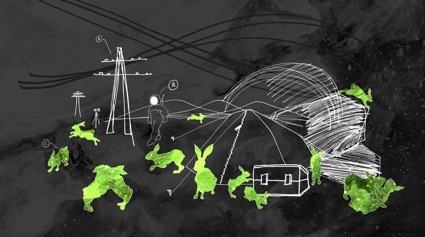
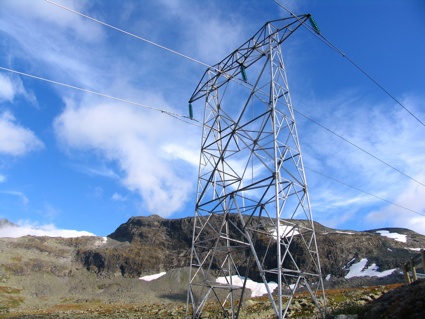
Hagen: The truth is the name comes from an encounter with an electricity pylon. Surrounded by this pristine wilderness the pylon looked like the first man made structure on a virgin planet -- which more or less then created the idea that this might be what it looks like when we start to colonise the moon.
Sue: So no, we're not necessarily all about science or space or pylons. We just started there.
The WCTM Pylon, somewhere around Sognefjellet, Norway, 2008
By the way, Hagen can you tell us what are the scope, objectives and functions of the Institute of General Theory?
Hagen:
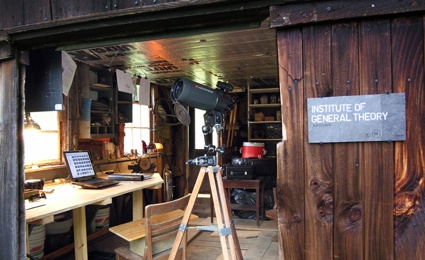
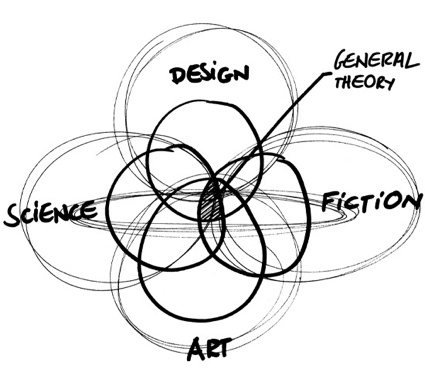
The Institute of General Theory is a project of indeterminate duration, for anything. It operates in an undefined area, in the grey zone where there is no distinction between fiction and science, art and craft, independent work and self exploitation; between game, experiment and paid work, between experimental and studio space, or between museum and university.
Jean-Baptiste Joly, Akademie Schloss Solitude, 2007.
After I graduated in 2001 at Merz Akademie Stuttgart, the Institute of General Theory became, besides my daily agency design job, my independent playground for experimental projects. Then, when I became a fellow at Akademie Schloss Solitudein 2005 the Institute turned into my full time artistic career. It's my operational format and combines pretty much everything I am interested in since early childhood until today in a professional dilettante way.
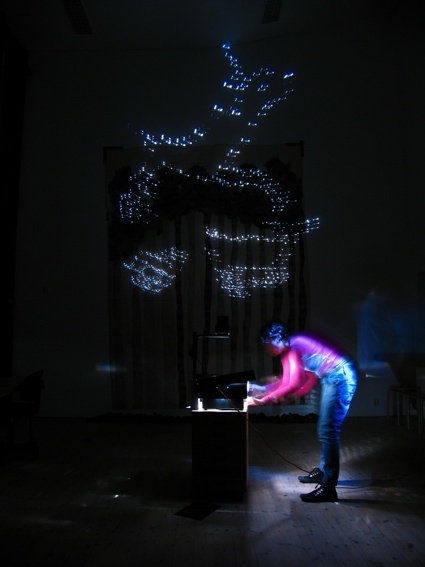
Institute of General Theory, 2007, at Hall Farm, Vermont, USA
I have another question for you, Hagen, your short bio says that your "artistic practice is exploring the gaps and connections between art and science to create New New Media." I sometimes write about the connections between art and science so i'm interested in your mentioning of the gaps between them? What are the most interesting/fascinating gaps between art and science? And should they remain gaps or should they somehow be made to disappear?
Hagen: Working with scientists is mostly fun and generates often interesting results for both sides. But academic artistic research makes me grumpy! There is a lot of art-science-art, science-art-science that takes itself way too serious that even tumbleweed would stop to roll. New New Media is Post Artistic Research, liberated from University fantasies about how things should be done according to the most recently developed textbooks.
Sue: I grew up with the Clangers and Blue Peter and a DIY attitude to life. What I like about the way Hagen operates is I can walk right in and join in without worrying if we do it right. Misunderstanding is actually even productive.
Hagen: In the last couple of years there is so much sophisticated theory that it is sometime hard to see the art behind it. I am not saying my own work is not based on mountains of theory but I like to offer the observer first an enjoyable view and if he wants he can go and discover as much more as he wants in my landscape and not the other way around.
Sue: This suits me too. I think theory like technology should not be the thing you notice first.
101 (Mostly) Harmless (Almost) Scientific Experiments to Try At Home
Last summer, you were showing 101 (Almost) Harmless (Mostly) Scientific Experiments to Try at Home in London. Could you share some of them with us?
And explain us how we could replicate one or two of them home too?
Hagen: Haha! The biggest experiment was definitely being holed up together for two months in ACME Project Space, a studio in Bethnal Green. Two options, homicide or art.
Sue: Indeed! Normally we work together on and off for say a couple of weeks max at a time and in between the work goes on online. This was altogether a different experience.
Hagen: The project was inspired actually by a children's book on science from the 1950s I think. You know the kind of thing. Make Your Own Atomic Bomb in 5 Easy Lessons.
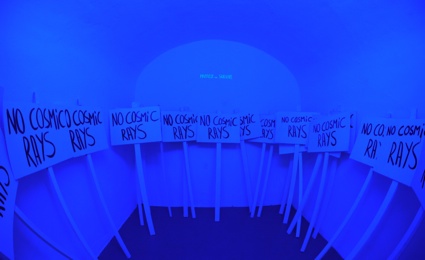
Sue: What people want to get up to in the privacy of their own homes is their business. Mostly I guess it does not involve black holes but I think amateur science is a great tradition which should be encouraged. So we decided to tackle anti-gravity with an electric hoist, built our own design for a future satellite disguised as an asteroid and began a campaign against cosmic rays.
Hagen: From what I learnt the Scottish Enlightenment seems to have taken place mostly in the pubs of Leith. I have no problem with that. Dilettantism was always a powerful driving force for progress and only in recent times has it become this negative aftertaste. I am very happy to be a professional Dilettante!
101 (Mostly) Harmless (Almost) Scientific Experiments to Try At Home (video)
Any upcoming projects, exhibition, residency, public presentation you could share with us?
Sue: The next thing we are definitely participating in this year is a special three day "Kosmica" festival at Laboratorio Arte Alameda with curator Nahum Mantra in Mexico City. "Republic of the Moon" will also travel on from Liverpool too and some more actions are in the pipeline.
Hagen: Also in September my latest work as the Institute of General Theory, "A Bucket full of Particles" will be part of On Dilettantism a wonderful show curated by Frank Motz at Halle 14, at Spinnerei in Leipzig, Germany.
... and of course ... (say it loud now!) ... NO COSMIC RAYS!
NO COSMIC RAYS, 2012
Authentic Goods from a Realistic Future is at EB&Flow, London until 1st September, 2012
Coming up:
On Dilettantism, Halle14, Spinnerei, Leipzig will open on 15th September and run till 18th November, 2012. It does look like a wonderful show indeed.
Kosmica Mexico will land at Laboratorio Arte Alameda, Mexico City, from 27th to 29th September, 2012
"Space Adventures #1" at Villa Rosenthal closed a few days ago.
Coming up:
On Dilettantism, Halle14, Spinnerei, Leipzig will open on 15th September and run till 18th November, 2012. It does look like a wonderful show indeed.
Kosmica Mexico will land at Laboratorio Arte Alameda, Mexico City, from 27th to 29th September, 2012
"Space Adventures #1" at Villa Rosenthal closed a few days ago.
Emmys 2012: Louis C.K.'s Digital Download Experiment Pays Off
7:42 PM PDT 9/23/2012 by Seth Abramovitch Original Site
"Louis C.K. Live at the Beacon Theater's" Emmy could shape the way entertainers produce and distribute their own starring vehicles.
Of all Sunday night's Emmy wins, none offer a more intriguing glimpse at TV's future than Louis C.K.'s Outstanding Writing for a Variety Special for Louis C.K. Live at the Beacon Theatre.
That's because the concert special wasn't produced by any TV studio, nor was it even initially meant to air on TV. It was made by C.K. for his fans, who paid $5 to download it directly from his website.
PHOTOS: Emmy Awards 2012: Red Carpet Arrival Photos
Edited and released just four weeks after the Nov. 2011 show it captures, the Live at the Beacon Theatre's business model was quietly revolutionary for the way it dispensed altogether with physical media, VOD and third-party streaming services like Hulu and Netflix.
The show would eventually air six months later on FX, the same cable network that airs the comedian's critically acclaimed comedy Louie -- which won C.K. another writing Emmy -- thus making it eligible for Emmy consideration.
STORY: The 2012 Primetime Emmy Awards Live
Explaining his reasoning [8] at the time to The New York Times, C.K. said, “Everybody is outnumbered, because everything in your wallet represents all these contentious relationships with these huge companies. ... You don’t have to have an iTunes account in good standing. You don’t have to have your credit card at Netflix updated. You can be a loser and watch this thing. You can be in prison.”
C.K. would later say in an appearance on Late Night with Jimmy Fallon that the experiment was a sucessful one, producing $1.1 million in gross profits, which he used to cover its $250,000 production costs. The rest of the profits were divided between crew bonuses, charitable donations, and, C.K. joked, the purchase of "a new penis."
STORY: Emmys 2012: The Winners React
Other comedians have since followed suit, with Jim Gaffigan and Aziz Ansari releasing similar comedy specials using the direct-to-consumer download business model.
But now the show is more than just a financial success. It's an Emmy-winner -- and the prospect of working around entertainment business middle-men has never looked more appealing.
As C.K deadpanned as he took the podium, "You know, I wanted another one, so that's nice."
That's because the concert special wasn't produced by any TV studio, nor was it even initially meant to air on TV. It was made by C.K. for his fans, who paid $5 to download it directly from his website.
PHOTOS: Emmy Awards 2012: Red Carpet Arrival Photos
Edited and released just four weeks after the Nov. 2011 show it captures, the Live at the Beacon Theatre's business model was quietly revolutionary for the way it dispensed altogether with physical media, VOD and third-party streaming services like Hulu and Netflix.
The show would eventually air six months later on FX, the same cable network that airs the comedian's critically acclaimed comedy Louie -- which won C.K. another writing Emmy -- thus making it eligible for Emmy consideration.
STORY: The 2012 Primetime Emmy Awards Live
Explaining his reasoning [8] at the time to The New York Times, C.K. said, “Everybody is outnumbered, because everything in your wallet represents all these contentious relationships with these huge companies. ... You don’t have to have an iTunes account in good standing. You don’t have to have your credit card at Netflix updated. You can be a loser and watch this thing. You can be in prison.”
C.K. would later say in an appearance on Late Night with Jimmy Fallon that the experiment was a sucessful one, producing $1.1 million in gross profits, which he used to cover its $250,000 production costs. The rest of the profits were divided between crew bonuses, charitable donations, and, C.K. joked, the purchase of "a new penis."
STORY: Emmys 2012: The Winners React
Other comedians have since followed suit, with Jim Gaffigan and Aziz Ansari releasing similar comedy specials using the direct-to-consumer download business model.
But now the show is more than just a financial success. It's an Emmy-winner -- and the prospect of working around entertainment business middle-men has never looked more appealing.
As C.K deadpanned as he took the podium, "You know, I wanted another one, so that's nice."
Subscribe to:
Comments (Atom)